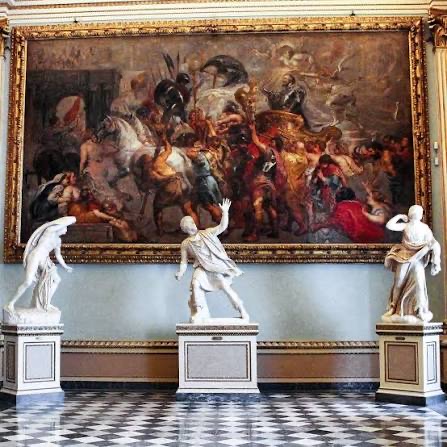


The paintings in the Uffizi Gallery cover roughly 350 years — from Cimabue's gold-ground Santa Trinita Maestà of the 1280s to Artemisia Gentileschi's blood-spattered Judith Slaying Holofernes — and they include a run of names no other museum can match wall for wall: Giotto, Botticelli, Leonardo, Michelangelo, Raphael, Titian, Caravaggio. The problem isn't finding great art here. It's deciding what to skip.
This guide solves that. Below are the thirteen paintings that repay real attention, what to actually look for in each, the smartest order to walk the rooms, and a one-hour shortlist for tight schedules. Prices and hours are cross-checked against the official Uffizi website (uffizi.it): €25 same-day or €29 booked ahead, Tuesday–Sunday 8:15–18:30, closed Mondays.
Quick Summary: The Must-See Paintings at a Glance
| Painting | Artist | Date | Why go |
|---|---|---|---|
| Santa Trinita Maestà | Cimabue | c. 1280–90 | Where the route — and Western painting's revival — begins |
| Ognissanti Madonna | Giotto | c. 1310 | The first Madonna with real weight and depth |
| Duke and Duchess of Urbino | Piero della Francesca | c. 1470s | The Renaissance's most famous profile portraits |
| Primavera | Botticelli | c. 1480 | A mythological puzzle with ~500 identified plant species |
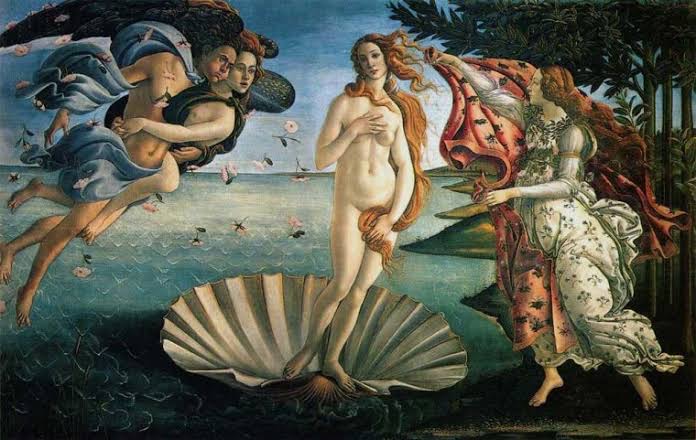
| Birth of Venus | Botticelli | c. 1485 | The painting everyone comes for |
| Annunciation | Leonardo da Vinci | c. 1472 | Leonardo's landscape mind, already visible in his early twenties |
| Adoration of the Magi | Leonardo da Vinci | 1481 | Unfinished — you see him thinking on the panel |
| Doni Tondo | Michelangelo | c. 1506 | His only surviving completed panel painting |
| Madonna of the Goldfinch | Raphael | c. 1506 | High Renaissance balance at its gentlest |
| Venus of Urbino | Titian | 1538 | The nude that scandalised and defined Venetian painting |
| Medusa | Caravaggio | c. 1597 | A scream painted on a ceremonial shield |
| Bacchus | Caravaggio | c. 1596–97 | A wine god who looks like a Roman street kid |
| Judith Slaying Holofernes | Artemisia Gentileschi | c. 1620 | Baroque violence by the era's greatest woman painter |
Where Painting Learned to Breathe: Cimabue, Giotto, Piero
The route opens with two monumental altarpieces that face the same problem — Madonna, child, throne, angels — a generation apart. Cimabue's Santa Trinita Maestà (c. 1280–90) still belongs to the Byzantine world: gold background, stacked angels, elegant flatness. Stand close and look at the throne's architecture; Cimabue is straining toward depth that his tradition doesn't yet allow.
Then turn to Giotto's Ognissanti Madonna (c. 1310). The Virgin has knees under her drapery, the throne has real space around it, and the angels overlap like people in a crowd. This is the hinge on which European painting turns — seeing the two works near each other is the single best art-history lesson the Uffizi offers, and most visitors rush past it toward Botticelli.
Piero della Francesca's Duke and Duchess of Urbino (c. 1470s) shows Federico da Montefeltro and Battista Sforza in strict profile — Federico from the left, hiding a lost right eye — painted without a gram of flattery. Look past the faces to the miniature landscapes behind them, lit like early morning.
The Botticelli Rooms: Birth of Venus and Primavera
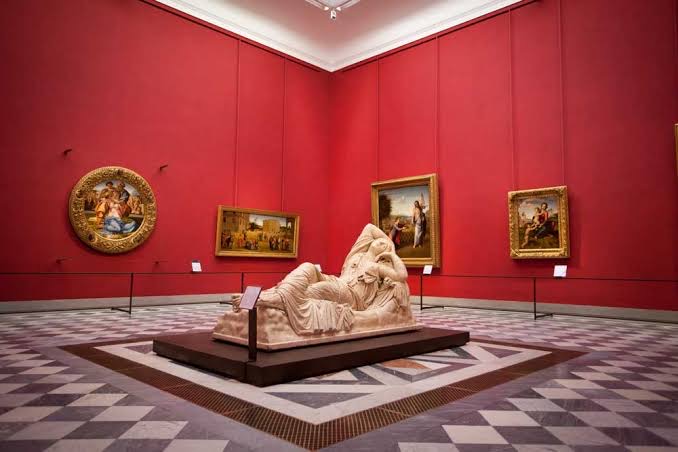
Sandro Botticelli (c. 1445–1510) spent almost his whole life in Florence, and the Uffizi holds the two paintings that made his name immortal. Primavera (c. 1480) is the harder, richer work: mythological figures — Venus at the centre, the Three Graces dancing, Zephyrus seizing the nymph Chloris — in an orange grove painted with botanical obsession. Scholars still argue about what it means; nobody argues about the flowers.
Birth of Venus (c. 1485) is the money shot, and it earns the crowds. Venus arrives on her shell, blown ashore by wind gods, her pose borrowed from ancient statues — a bridge between pagan antiquity and Renaissance Florence. Notice how little Botticelli cares about anatomy: the impossibly long neck and sloping shoulder exist because the line is more beautiful that way. Unusually for the period, it's painted on canvas rather than wood panel.
Leonardo da Vinci: Two Paintings, Two Lessons
The Annunciation (c. 1472) is early Leonardo — he was around twenty — and already unmistakably him. The angel's wings are studied from real birds, the Virgin's lectern is carved with antiquarian precision, and the misty landscape dissolving toward distant mountains previews the atmospheric depth he'd spend a lifetime perfecting. Look at the angel's shadow on the grass: painted lawn, observed light.
The Adoration of the Magi (1481) was abandoned when Leonardo left for Milan, and its unfinished state is exactly why it's worth your time. Underdrawing, half-built figures and ghostly horsemen show his compositional thinking laid bare — a swirl of agitated humanity around a calm Madonna. Few places let you watch a genius mid-thought; this panel does. For more on his rooms, see Caravaggio, da Vinci & Michelangelo at the Uffizi.
High Renaissance: Michelangelo and Raphael
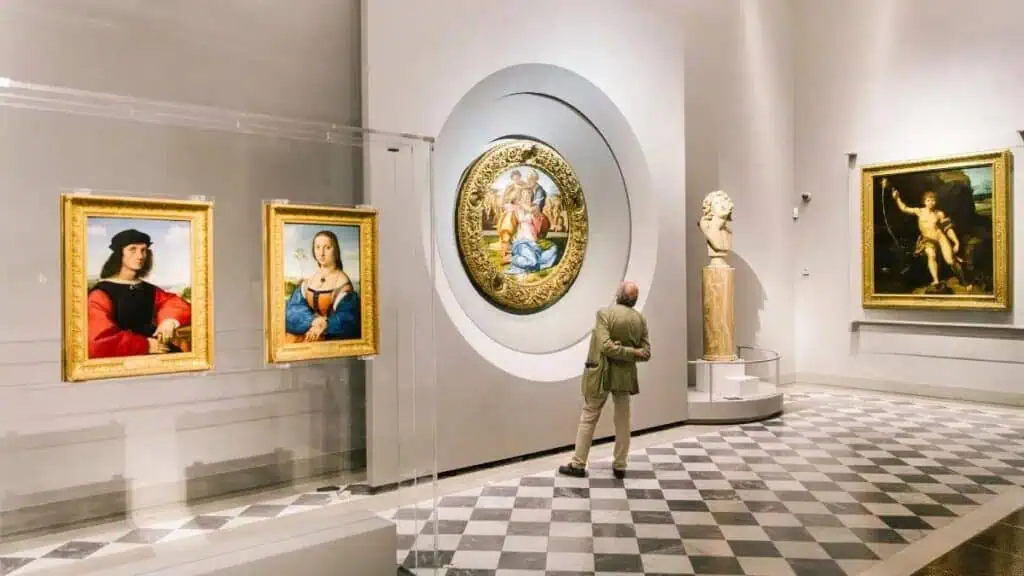
Michelangelo's Doni Tondo (c. 1506) is his only surviving completed panel painting — the one place on earth to see a finished Michelangelo painting outside a fresco cycle. The Holy Family twists in a spiral of sculptural muscle, the colours are almost acidic in their brightness, and the nude youths in the background baffle interpreters to this day. The carved frame, likely designed with the painting, is part of the work — don't crop it out of your photo.
A few steps of art history later comes Raphael's Madonna of the Goldfinch (c. 1506): Mary with the infant Christ and John the Baptist, who offers a goldfinch — a traditional symbol of the Passion. Where Michelangelo strains, Raphael resolves; the pyramid composition and soft Leonardo-learned modelling make it the calmest picture in the building. Painted the same years as the Doni Tondo, by a rival in his early twenties.
Titian's Venus of Urbino
Titian's Venus of Urbino (1538) is the Venetian answer to everything Florence stood for: colour over line, flesh over ideal. A young woman reclines on a bed, looking straight at you, a sleeping dog at her feet. It scandalised generations, and it taught every later painter of the nude — Manet's Olympia included — how the game works.
Baroque Drama: Caravaggio and Artemisia
Caravaggio's Medusa (c. 1597) is painted on a ceremonial shield — a severed head at the instant of death, snakes writhing, mouth open in a scream. The convex surface makes the head bulge into your space; many believe the horrified face is the artist's own. Nearby hangs his Bacchus (c. 1596–97), a wine god with dirty fingernails and a drinker's flush, offering you a glass across four centuries; the Sacrifice of Isaac completes the Uffizi's Caravaggio trio.
Artemisia Gentileschi's Judith Slaying Holofernes (c. 1620) takes Caravaggio's stagecraft and adds physical conviction: two women pinning a general to his bed and sawing through his neck, painted with an unblinking realism that still stops rooms. Gentileschi was the most successful woman painter of her century, and this is her signature subject.
The Tribuna and the Medici Venus
One non-painting stop is compulsory. The Tribuna — the octagonal, red-walled treasure chamber designed by Buontalenti in 1584 — was built to display the Medici's most precious objects, and its star is the ancient Medici Venus, the marble that grand tourists once crossed Europe to see. You view the room from its doorways rather than walking in, which keeps it uncrowded and photogenic. More on the space itself in our inside the gallery walkthrough.
How to Walk It: A Chronological Strategy
The Uffizi is laid out chronologically across the top two floors, so the building does the curating for you. Work with it:
- Start at the start. Cimabue and Giotto first — five minutes there makes everything after read as a story, not a list.
- Botticelli early. If you booked the 8:15 slot, consider going straight to Birth of Venus before the tour groups land, then loop back to the beginning.
- Don't sprint the corridors. The East and West corridors are lined with ancient sculpture and frescoed ceilings; the windows frame the Arno and Ponte Vecchio.
- Save Caravaggio for last. The Baroque rooms come late on the route — a strong finish rather than an anticlimax.
- Budget 2.5–4 hours for the full route; dozens of rooms means pacing beats completism.
Only Have One Hour? See These Seven
- Botticelli — Birth of Venus and Primavera (they hang near each other)
- Leonardo — Annunciation
- Michelangelo — Doni Tondo
- Raphael — Madonna of the Goldfinch
- Titian — Venus of Urbino
- The Tribuna — a two-minute pause at the doorway for the Medici Venus
- Caravaggio — Medusa
That run is doable in 60–75 minutes at the 8:15 opening; closer to 90 mid-morning. If speed matters, a skip-the-line ticket with the earliest slot is worth more than any other optimisation.
Tickets for Seeing the Paintings
Per the official Uffizi website (uffizi.it), standard entry is €25 at the door or €29 booked in advance, with a €16 afternoon ticket after 16:00, €2 for EU citizens 18–25, and free entry under 18. On Tiqets, reserved entry with an audio guide starts from €25 — useful here specifically, because wall labels give you a title and a date and not much else. Full options in our ticket prices guide; if you'd rather have the stories told to you in front of the canvases, compare a guided tour or the audio tour options.
Skip the ticket-office queue
Compare timed-entry tickets, audio guides and tours with instant confirmation and free cancellation on most options.
Photography Rules
Photos are allowed for personal use — with three hard exceptions: no flash, no tripods, no selfie sticks. Flash is the one that gets you told off fastest, so switch it off before you enter. Shoot slightly off-axis to beat reflections on glass-protected works like the Medusa, and remember the corridor windows: the Arno and Ponte Vecchio views make better photos than most postcards, best before midday haze.
Paintings in the Uffizi Gallery: The Bottom Line
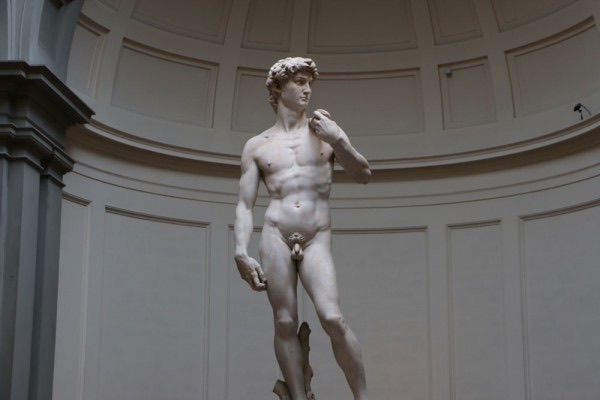
Treat the paintings in the Uffizi Gallery as a story with thirteen chapters, not a checklist. Start with Cimabue and Giotto so the Renaissance means something when you reach it, give Botticelli the early-morning slot, stand long enough at the Doni Tondo and Venus of Urbino to see why painters argued about them for centuries, and let Caravaggio close the show. Book a timed ticket in advance — 8:15 or post-16:00 — and the art, not the crowd, is what you'll remember. And if a companion asks where David is, our Statue of David guide has the answer: a different museum, 15 minutes away.
Frequently Asked Questions
What are the most famous paintings in the Uffizi Gallery?
Botticelli's Birth of Venus and Primavera lead the list, followed by Leonardo da Vinci's Annunciation, Michelangelo's Doni Tondo, Raphael's Madonna of the Goldfinch, Titian's Venus of Urbino, Caravaggio's Medusa and Bacchus, and Artemisia Gentileschi's Judith Slaying Holofernes.
How many paintings should I plan to see at the Uffizi?
Focus on 13–15 key works. The main route covers dozens of rooms and a typical visit takes 2.5–4 hours; trying to study everything leads to fatigue by the halfway point. See the highlights properly, then browse whatever else catches your eye.
Can I see the best Uffizi paintings in one hour?
Just about. Go straight to the Botticelli rooms for Birth of Venus and Primavera, then Leonardo's Annunciation, Michelangelo's Doni Tondo, Raphael's Madonna of the Goldfinch, Titian's Venus of Urbino, and finish with Caravaggio's Medusa. Book the 8:15 slot so crowds don't slow you down.
Is the Mona Lisa in the Uffizi?
No — the Mona Lisa is in the Louvre in Paris. The Uffizi holds two major Leonardo da Vinci works instead: the Annunciation and the Adoration of the Magi.
Are photos allowed in the Uffizi Gallery?
Yes. You can photograph the paintings for personal use, but flash, tripods and selfie sticks are banned. Keep your distance from the works and watch for signs in special exhibitions.
Are the paintings displayed in chronological order?
Broadly yes. The route runs from 13th-century gold-ground altarpieces by Cimabue and Giotto through the early and High Renaissance to Titian and Caravaggio, so following the numbered rooms doubles as a walk through three centuries of art history.
Is Michelangelo's David among the Uffizi's artworks?
No — David is a sculpture and the original stands in the Galleria dell'Accademia, a 15-minute walk away. The Uffizi's Michelangelo is the Doni Tondo, his only surviving completed panel painting. The gallery's most famous statue is the ancient Medici Venus in the Tribuna.
How much does it cost to see the Uffizi paintings?
Per the official Uffizi website (uffizi.it), a standard ticket is €25 same-day or €29 booked in advance; EU citizens aged 18–25 pay €2 and under-18s enter free. Reseller tickets with audio guide start around €25 on Tiqets.
Prices and opening hours mentioned on this page are based on the official Uffizi website (uffizi.it) and reseller listings at the time of writing. They can change without notice — always double-check on the official website before you travel.